
At first, learn Korean can feel fun. However, it can also feel hard when every study day looks the same.
For example, flashcards may work well on Monday. On Tuesday, however, you may need an easier way to begin.
Because of that, Korean games can help. Instead of forcing a long study block, you can start with one small game.
Also, a word search can help you read Hangul. Meanwhile, bingo can help you notice Korean phrases in a drama.
As a result, review feels lighter. More importantly, it becomes easier to learn Korean again.
Games do not need to replace your Korean study routine. Instead, they can help you learn Korean in small, repeatable steps.
What this guide will help you do as you learn Korean
Use games with one clear goal
Why It Can Feel Hard to Learn Korean with a Routine
Often, learners do not stop because they dislike Korean. Instead, they stop because the routine feels hard to restart.
At first, a strict plan can feel useful. However, it can turn into one more task.
Small starts make study easier
Over time, your word list grows. Also, your notes spread across apps, books, and screenshots.
Then, even a short session can feel too big. So, a game can make the first step smaller.
For example, one puzzle page feels easier than a full study block. As a result, you may start sooner.
Games can help you come back
For that reason, a game does not need to teach everything. Instead, it can help you return to Korean.
After that, add one tiny review task. For example, write three words, say one phrase, or make one short sentence.
In addition, a simple routine can make games more useful. If you want to learn Korean with a steadier plan, read How to Build a Korean Study Routine You’ll Actually Stick With.
What Makes a Game Useful When You Learn Korean?
Of course, not every game helps you learn Korean. In fact, some games only keep you busy.
However, a useful game has one clear study action. For example, it helps you notice, remember, read, or use Korean.
Look for one learning action
For example, a word search helps you scan Hangul. Also, bingo helps you notice repeated phrases.
In addition, a matching game helps you remember meanings. Therefore, the game still supports real study.
A helpful game to learn Korean usually supports one of these skills
Keep the game simple
Most importantly, a useful game should not feel like a test. Instead, it should make one skill easier to practice.
Because of that, simple games can work well. Also, they are easy to start and repeat.
The Best Game Types to Learn Korean
Different games support different skills. Therefore, choose your goal before you choose the game.
For example, do you want to read Hangul, remember words, or notice drama phrases?
Choose one Korean skill first
Once the goal is clear, the game has a purpose. Also, it becomes easier to see if the game is helping.
Word search games to learn Korean Hangul reading
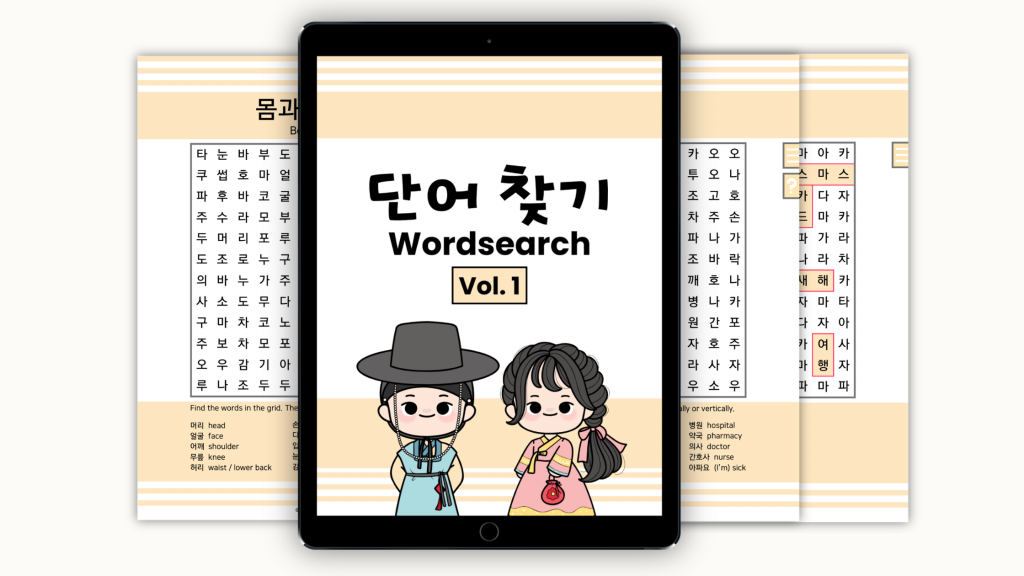
For example, Korean word searches are useful when you know Hangul but want to read it faster.
Instead of looking at single letters, you scan full syllable blocks. Because of that, your eyes get more practice.
Also, word searches can help with spelling, word shape, and word review.
Bingo games to learn Korean through K-drama noticing
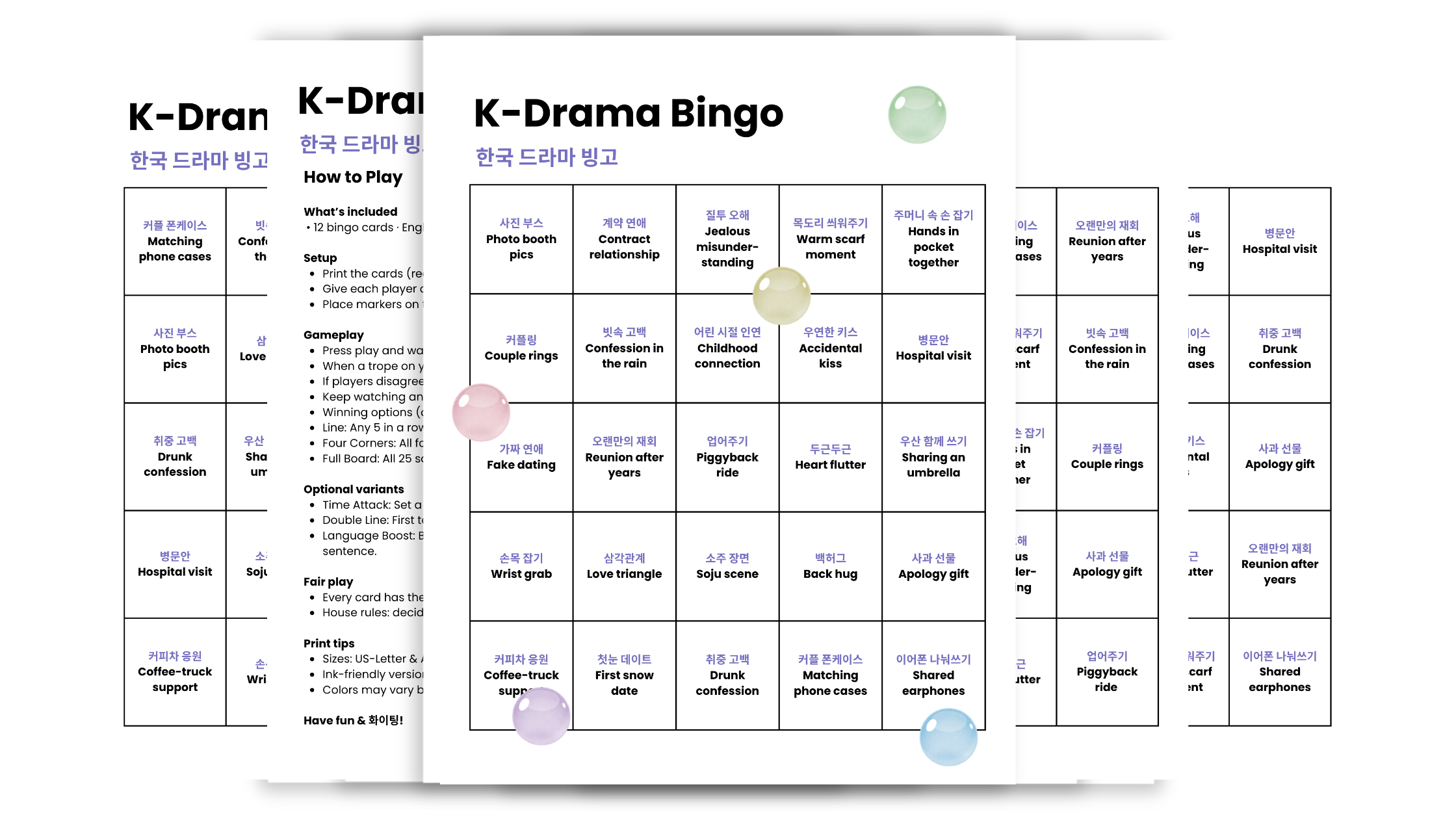
K-drama bingo is not a grammar lesson. Instead, it is a noticing game.
While you watch, you look for scenes, words, and repeated phrases. For example, you can listen for greetings or apology phrases.
As a result, drama time becomes more active. Still, it does not feel strict.
Matching games to learn Korean words
For example, matching games connect Korean words with meanings, images, or simple scenes.
Also, they make memory practice feel more active than reading a list.
Use matching games in tiny sets
First, start with five to ten words. That way, the game stays easy and useful.
Matching ideas for Korean words
For example, pair a Korean word with an English meaning.
Also, match a Korean phrase with a situation.
Then, connect a verb with a past or present form.
Finally, match a drama phrase with a feeling or scene.
Sentence games to learn Korean grammar
Similarly, sentence games help you move from reading to using Korean.
First, write simple word cards. Then, move the cards into a sentence. Finally, change one card and read the new sentence.
Keep sentence games very short
To keep it simple, use only one grammar pattern at a time. Then, repeat it with new words.
Mini sentence practice
저는 오늘 커피를 마셔요.
For example, this means: I drink coffee today.
저는 집에서 공부해요.
Also, this means: I study at home.
How to Learn Korean with Word Searches
At first, a word search looks simple. However, it can still help you learn Korean when you add a review step.
Step 1: Read the Korean word list out loud
First, read each Korean word slowly.
Here, the goal is not a perfect sound. Instead, connect the written word with sound.
Step 2: Search for the word in Hangul
Next, look for the word in the puzzle.
As you search, this trains your eyes to see syllable blocks. Also, it helps you notice spelling.
For example, 친구 and 진구 can look close when you read too fast.
Step 3: Say the meaning after you find it
After you find a word, do not stop at circling it.
Instead, say the meaning out loud. Also, you can write it beside the puzzle.
As a result, the puzzle becomes a memory task.
Step 4: Use three words in mini sentences
After the puzzle, choose three words.
Then, make tiny sentences. They can be very simple.
Finally, read each sentence out loud once.
Simple learn Korean sentence examples
친구가 있어요.
For example, this means: I have a friend.
학교에 가요.
Also, this means: I go to school.
음식을 먹어요.
Finally, this means: I eat food.
A short word search routine
This routine keeps the game light. However, it still gives you a clear path.
| Time | Activity | Study purpose |
|---|---|---|
| 2 minutes | First, read the word list out loud | Connect sound and Hangul |
| 7 minutes | Then, complete part of the word search | Practice word reading |
| 3 minutes | Next, review meanings | Remember words |
| 3 minutes | Finally, write 2–3 mini sentences | Use the words once |
How to Learn Korean with K-Drama Bingo
For many learners, K-dramas are one reason they love Korean. However, watching a drama is not always the same as study.
Still, drama time can help. However, it needs one small language action.
Use bingo as a noticing tool
If you want to learn Korean from dramas, do not try to understand every line.
Instead, choose one focus. For example, listen for greetings, food words, or feelings.
Then, when you mark a square, write one Korean word or phrase you heard.
K-drama bingo focus to learn Korean phrases
First, choose one episode. Then, collect five useful words or phrases while you play.
미안해요 — I’m sorry
잠깐만요 — Wait a moment
좋아요 — It’s good / I like it
왜요? — Why?
괜찮아요 — It’s okay
Try a solo K-drama game
First, choose one episode and one bingo card.
Next, mark scenes as you notice them. Then, write one phrase for five marked squares.
Finally, choose your favorite phrase and make one new sentence with it.
Use bingo with friends
When you study Korean with friends, everyone can use a different bingo card.
Then, when someone marks a square, they can share the scene type and one Korean word. As a result, the game stays light and social.
A Simple Weekly Routine to Learn Korean with Games
Games work best when they add variety. Therefore, you do not need to use them every day.
Instead, use them as warm-ups, review tools, or low-energy sessions.
Keep the routine small
For example, one game session can help you restart after a busy week.
Also, a short game can keep Korean in your day without asking for too much energy.
| Day | Game activity | Korean skill |
|---|---|---|
| Monday | First, try one Korean word search page | Hangul and word reading |
| Wednesday | Then, play a matching game with 10 words | Memory and meaning |
| Friday | Next, use K-drama bingo during one episode | Phrase noticing |
| Sunday | Finally, review your game notes | Active recall |
Common Mistakes to Avoid When You Learn Korean with Games
In general, games can make study feel lighter. However, a few small habits make them more useful.
Trying to learn Korean without reviewing anything
At first, a game can feel fun. However, learning becomes stronger when you add review.
After any Korean game, write down three words or phrases you noticed.
Choosing games that are too hard
However, if the game is above your level, it may feel frustrating.
Therefore, start with reading, matching, and short phrases. Later, you can add sentences or listening notes.
Turning every game into a test
Most importantly, games should not feel like a final exam.
Instead, keep the goal small. Otherwise, the activity may stop feeling useful.
Never using the words again
Over time, a word can fade fast if you only see it once.
So, add one tiny follow-up task. For example, write a sentence, say the word, or review it tomorrow.
Printable Games to Learn Korean Through Cozy Self-Study
Finally, printable games are helpful when you want to learn Korean away from another app screen.
For example, you can print them, use them on a tablet, or keep them in your Korean binder.
In addition, you can build them into a cozy study routine. For a deeper guide on printable study pages, read How to Use Printable Korean Worksheets Without Feeling Overwhelmed.
Use a word search for quiet review
If you like calm puzzle-style study, the Korean Word Search Puzzle from Hanyari Design is a gentle option.
Also, it helps you practice Hangul reading and word review. In addition, it includes 15 Korean word search puzzles.
The printable version works on paper. Meanwhile, the digital version works on a tablet.
Use K-drama bingo for playful noticing
Meanwhile, for drama fans, the Korean Drama Bingo Game is a playful option.
Also, it works for watch parties, solo drama nights, clubs, or cozy study sessions.
In addition, it includes 12 bingo cards with 25 classic K-drama tropes. Each square includes English and Hangul.
Explore playful printables to learn Korean
Add more variety to your learn Korean routine with calm, printable games. First, start with one small activity. Then, collect a few words and keep the routine light.
FAQ
Can you really learn Korean with games?
Yes. However, games work best when they include real Korean practice. For example, they can support review, reading, and phrase noticing.
Are Korean word searches good for beginners?
Yes. For example, Korean word searches can help beginners practice Hangul and word reading. However, they work best with a short review step.
How can I use K-dramas to learn Korean?
First, choose one small focus while watching. For example, listen for greetings or apology phrases. Then, write down one phrase from a marked scene.
What are the best games to learn Korean for self-study?
For example, good options include word searches, matching games, bingo, memory cards, and sentence cards. However, the best game depends on your goal.
Should I use games every day to learn Korean?
No, you do not have to. Instead, use games when review feels hard to start. For many learners, two or three short sessions per week can be enough.