
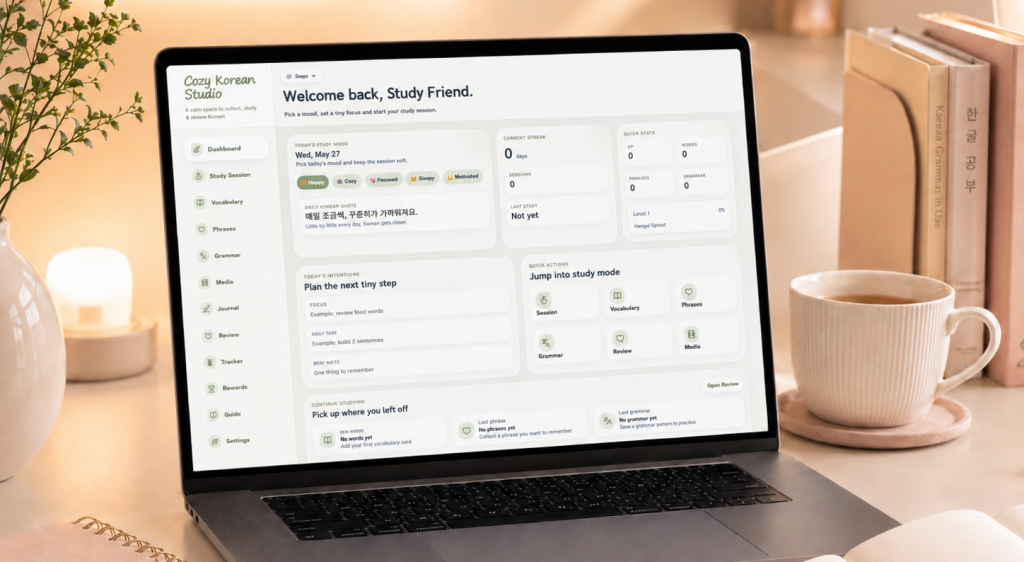
Learning Korean at home can feel exciting at first.
You save a few YouTube lessons. You download printable worksheets. You follow Korean study accounts. You open a language app. You hear a useful phrase in a K-drama and tell yourself, “I should remember that.”
And for a while, it feels like you are building something.
But then your notes start to scatter.
One vocabulary list is in your notebook. A grammar explanation is saved as a screenshot. A useful phrase is somewhere in your phone notes. Your printable worksheet is half-filled. Your K-drama vocabulary is mixed with random song lyrics. And when you finally sit down to study, you spend more time trying to find your materials than actually learning Korean.
The problem is not that you are lazy.
Most of the time, the problem is that your Korean study routine does not have a simple place to land.
You do not need a perfect Korean routine. You need one you can come back to.
In this guide, I’ll show you how to build a calm Korean study routine that includes vocabulary, phrases, grammar, K-media notes, review, and gentle progress tracking — without making your study time feel overwhelming.
- organize Korean vocabulary without losing your notes
- save useful phrases from K-dramas, K-pop, YouTube, and lessons
- turn grammar patterns into your own sentences
- review old material instead of only collecting new words
- build a calmer Korean self-study habit
Why Korean self-study gets messy so quickly
Korean self-study can become overwhelming because there are so many interesting things to learn.
You may want to practice Hangul, memorize vocabulary, understand grammar, watch dramas without subtitles, read song lyrics, improve pronunciation, use printable worksheets, write journal entries, and maybe even prepare for a trip to Korea.
All of that sounds fun.
But when everything lives in different places, it becomes hard to continue.
You might have:
- vocabulary in one notebook
- grammar notes in another file
- screenshots from Instagram or TikTok
- phrases saved from K-dramas
- printable worksheets in a folder
- flashcards in an app
- random notes in your phone
- a half-started study tracker you forgot about
This is why many Korean learners do not necessarily need more resources.
They need a simple system.
A good Korean study routine should help you answer three questions:
- What am I studying today?
- Where do I save what I learn?
- When will I review it again?
Once those three things are clear, Korean self-study starts to feel much more manageable.
Step 1: Choose one small Korean study focus for the day
One of the easiest ways to overwhelm yourself is to try to do everything in one study session.
You sit down and tell yourself:
“I need to review vocabulary, study grammar, practice listening, write sentences, watch a Korean video, fill out a worksheet, and maybe organize my notes.”
That sounds productive, but it often makes you avoid studying altogether.
Instead, choose one small focus for the day.
For example:
- Today I will review 10 Korean words.
- Today I will learn one grammar pattern.
- Today I will save three useful phrases from a K-drama.
- Today I will write two simple Korean sentences.
- Today I will finish one printable worksheet.
- Today I will review my old notes for 10 minutes.
Small study sessions are not a failure. They are how you build consistency.
A 15-minute Korean session with one clear goal is better than a two-hour plan that feels so heavy you never start.
Before you open your textbook, worksheet, app, or planner, ask yourself: What is the one thing I want to finish today?
That one question can make your routine feel calmer immediately.
Step 2: Keep your Korean vocabulary in one place
Vocabulary is one of the first things Korean learners collect.
And that makes sense. You need words to understand sentences, shows, songs, captions, menus, messages, and everyday conversations.
But Korean vocabulary becomes much easier to review when it is organized.
Instead of writing a random list like this:
- 먹다 = to eat
- 학교 = school
- 예쁘다 = pretty
- 지금 = now
Try adding a little more context.
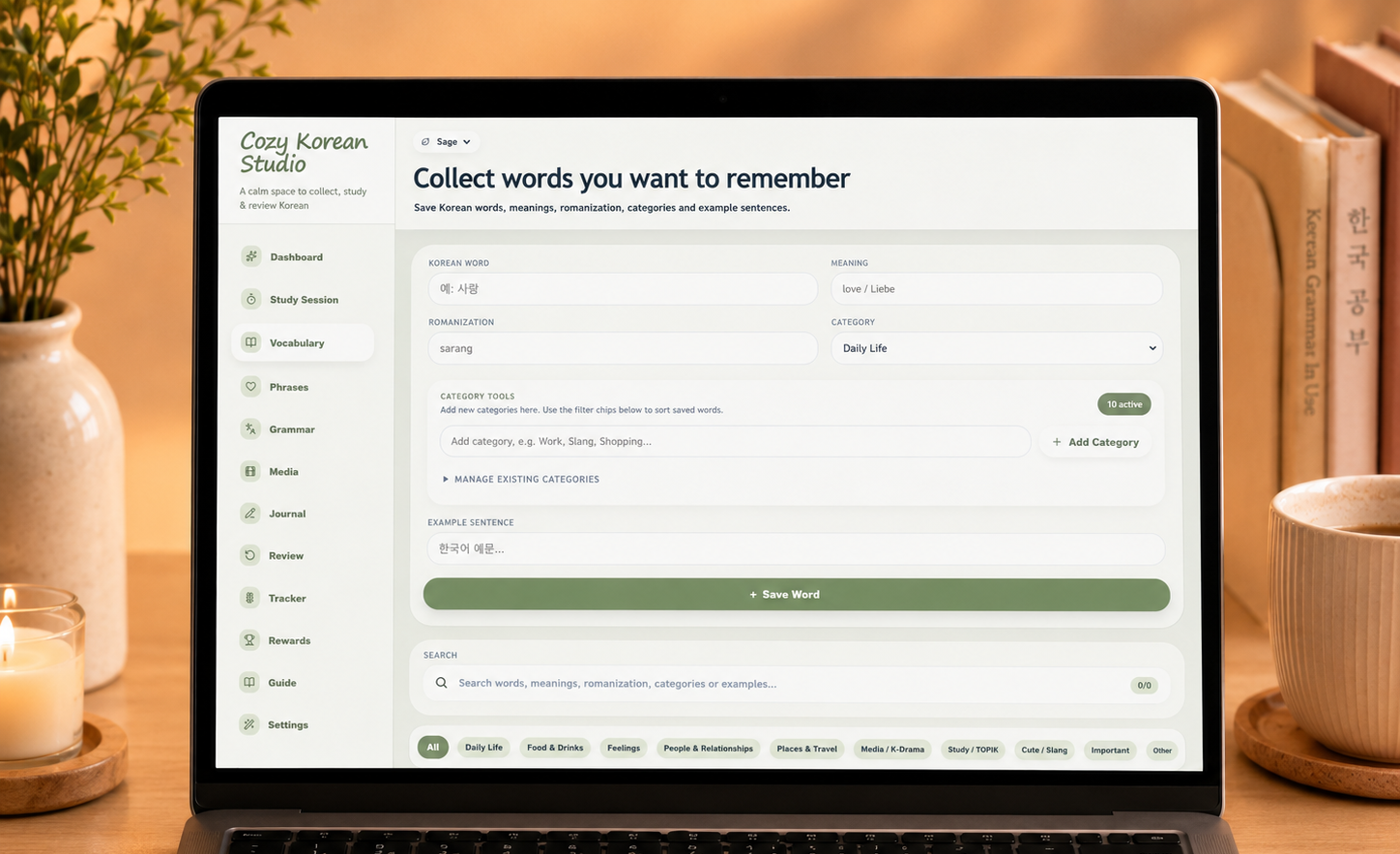
A useful Korean vocabulary tracker can include:
- Korean word
- English meaning
- Category
- Example sentence
- Source
- Review status
Example vocabulary note
Word: 먹다
Meaning: to eat
Category: Verbs
Example: 저는 김밥을 먹어요.
Source: Lesson / Drama / YouTube / Worksheet
Status: Learning
This gives the word a place in your memory.
You are no longer just collecting vocabulary. You are building a usable word bank.
I also recommend separating vocabulary by category when possible. Categories like food, emotions, verbs, adjectives, school, travel, daily life, family, and K-drama phrases can make review easier later.
But do not make the system too complicated.
A simple vocabulary tracker you actually use is better than a beautiful complex one you abandon after two days.
This is also why I like having one clear place for Korean vocabulary instead of keeping words in random notes, screenshots, and half-filled pages.
Step 3: Save phrases separately from single words
A common mistake in Korean self-study is mixing single words and full phrases together.
Both are useful, but they work differently.
A word is something like:
진짜 — really
A phrase is something like:
진짜요? — Really?
A natural expression is something like:
말도 안 돼. — No way. / That makes no sense.
Phrases are powerful because they show you how Korean is used in real situations.
This is especially helpful when you learn Korean through dramas, K-pop, variety shows, YouTube videos, webtoons, or books. You are not just learning vocabulary. You are learning tone, emotion, and context.
When you hear or read a useful phrase, save it with a few simple notes:
- Korean phrase
- Natural meaning
- Where you heard it
- Situation or mood
- Your own example sentence
Example phrase note
Phrase: 뭐 하는 거예요?
Meaning: What are you doing?
Source: K-drama scene
Mood: confused / surprised / casual
My sentence: 지금 뭐 하는 거예요?
This makes phrases much more useful later.
Instead of trying to memorize random lines from dramas, you start building a personal phrase bank you can actually review and reuse.
Step 4: Make Korean grammar practical, not scary
Korean grammar can feel intimidating, especially when explanations get long.
But your grammar notes do not need to look like a textbook.
In fact, they are often more helpful when they are simple.
For each grammar pattern, try writing:
- Grammar pattern
- Short meaning
- One example sentence
- When to use it
- Your own sentence
Example grammar note
Pattern: -고 싶어요
Meaning: I want to…
Example: 한국어를 배우고 싶어요.
Use it when: Talking about something you want to do
My sentence: 저는 커피를 마시고 싶어요.
That is enough for a first grammar note.
You can always add more later.
The goal is not to collect endless explanations. The goal is to make grammar usable.
A good Korean grammar journal should help you move from:
“I kind of understand this pattern.”
to:
“I can make my own sentence with this pattern.”
That shift matters.
When you learn a new Korean grammar point, do not stop after reading the explanation. Write at least one sentence of your own. Even if it is simple, it trains your brain to use the pattern actively.
Simple sentences are not too easy. They are the foundation.
Step 5: Turn K-dramas, K-pop, YouTube, and books into study material
Korean media can be one of the most motivating parts of learning the language.
You may start learning Korean because of a drama, a song, a favorite actor, a YouTube channel, Korean food content, webtoons, or travel dreams.
That emotional connection is valuable.
But there is one small problem.
It is easy to watch Korean content and feel like you are studying, even when you are mostly just consuming.
That does not mean you need to pause every five seconds. That would make the experience exhausting.
When you watch a K-drama scene, listen to a song, read lyrics, or watch a Korean YouTube video, save only one useful word, one natural phrase, and one sentence pattern.
For example, after watching a short scene, you might save:
- Word: 약속 — promise / appointment
- Phrase: 어디 가요? — Where are you going?
- Pattern: -고 싶어요 — I want to…
This keeps Korean media study light and realistic.
You are not trying to understand everything. You are training yourself to notice Korean in context.
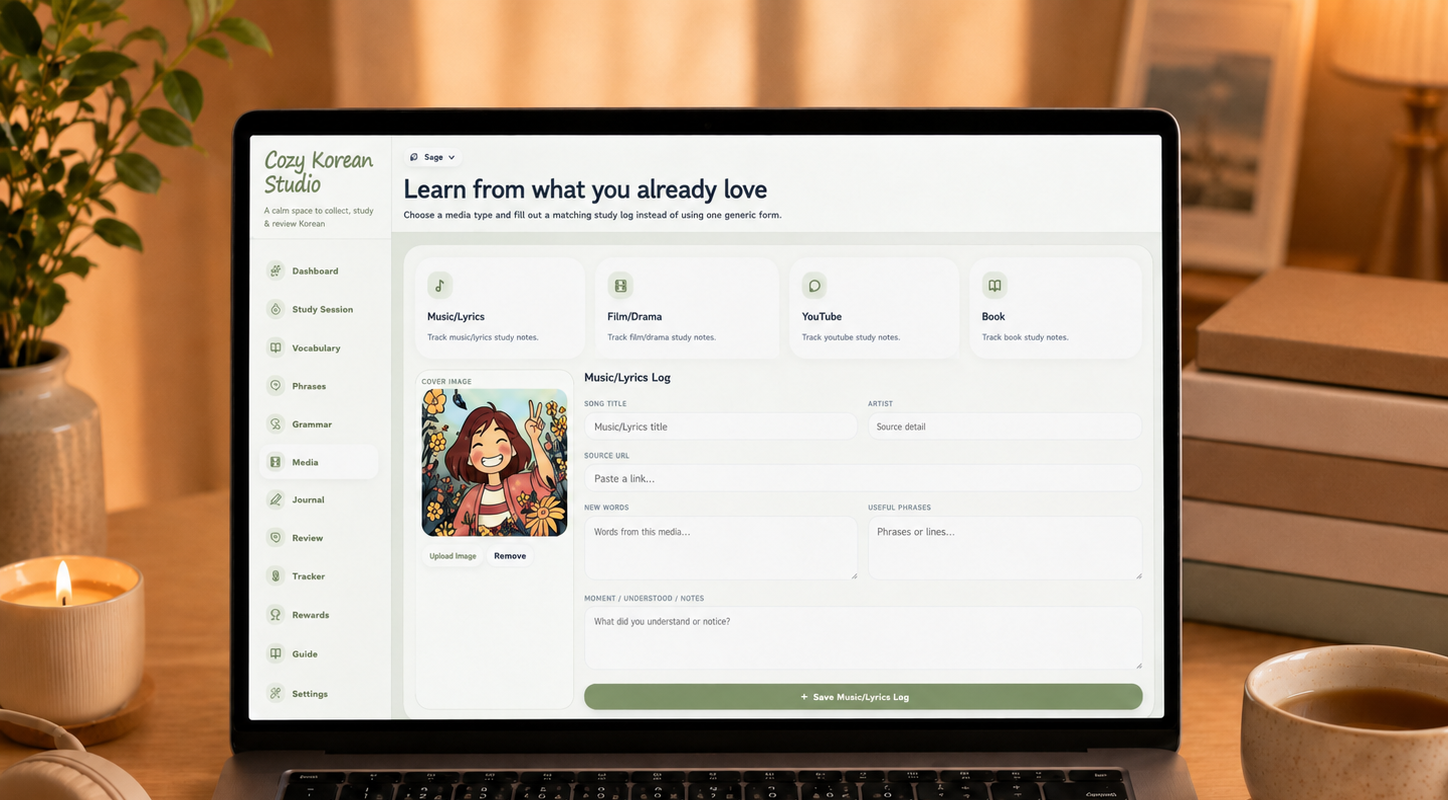
A K-media log can be helpful here because it gives your drama, music, YouTube, or book notes a home. Instead of letting useful phrases disappear after watching, you can turn them into review material.
You can track:
- Title
- Episode or video
- Useful words
- Favorite phrase
- Grammar pattern
- Mood or context
- Notes to review later
This makes Korean media feel less passive and more connected to your actual study routine.
Step 6: Review before you add more
Collecting Korean notes feels productive.
Reviewing them is what makes them useful.
Many learners keep adding new words, new grammar, new screenshots, new worksheets, and new phrases without returning to the older material.
But Korean does not stick just because you wrote it down once.
You need to see it again.
And again.
And again, in a way that does not feel painful.
That is why review should be part of your routine from the beginning.
You can keep it very simple.
5-minute Korean review
- Review 3 old words
- Review 2 phrases
- Review 1 grammar pattern
15-minute Korean review
- Review 10 vocabulary cards
- Read 3 old example sentences
- Practice 1 grammar pattern
- Write 1 new sentence
30-minute Korean review
- Review vocabulary
- Review phrases
- Practice one grammar point
- Revisit one K-media note
- Write a short journal entry
Review does not need to be complicated.
The most important thing is that your review material is easy to find.
When your vocabulary, phrases, grammar notes, and media notes are scattered across five different places, review becomes harder than it needs to be.
But when everything is organized, review feels like the natural next step.
Step 7: Track your progress gently
Progress tracking should not make you feel guilty.
It should not become another reason to criticize yourself.
A Korean study tracker should simply remind you that small steps count.
You can track things like:
- Study date
- Study minutes
- Session type
- Mood
- Vocabulary reviewed
- Grammar practiced
- Phrases saved
- Media studied
- Notes for next time
This helps you see patterns.
Maybe you study better in the morning. Maybe you review more consistently when sessions are short. Maybe K-drama notes keep you motivated. Maybe grammar feels easier when you write your own example sentences.
Tracking helps you notice what works for you.
It also helps you see progress that is easy to miss.
One saved phrase counts.
One reviewed word counts.
One sentence written by yourself counts.
One 10-minute session counts.
You do not have to study Korean perfectly to make progress.
You just have to keep returning.
A simple weekly Korean study routine for beginners
Here is a gentle weekly routine you can use as a starting point.
You can adjust it depending on your level, energy, and schedule.
| Day | Focus | What to do |
|---|---|---|
| Monday | Vocabulary | Add 5–10 useful Korean words and write one example sentence. |
| Tuesday | Grammar | Study one grammar pattern and create your own sentence. |
| Wednesday | Phrases | Save 3 useful Korean phrases from a lesson, drama, song, or video. |
| Thursday | Review | Review old vocabulary, phrases, and grammar notes. |
| Friday | K-media | Watch or listen to Korean content and use the 3-save rule. |
| Saturday | Writing | Write a tiny Korean journal entry using words you already know. |
| Sunday | Reset | Look back at your week and choose your next focus. |
This makes your Korean study routine feel intentional without making it strict.
What tools can you use for your Korean study routine?
There is no single perfect Korean study tool.
The best tool is the one you will actually return to.
Printable Korean worksheets
Printable worksheets are great when you want focused practice.
Best for: Hangul practice, vocabulary exercises, grammar drills, sentence building, writing practice, and screen-free study sessions.
Notebook or binder
A notebook is great if you like handwriting, decorating pages, and making your Korean study feel personal.
Best for: free writing, personal notes, vocabulary lists, and study journaling.
Digital planner
A digital planner can be useful if you enjoy using a tablet or stylus.
Best for: reusable pages, visual planning, handwritten digital notes, and flexible layouts.
Offline Korean study web app
An offline Korean study web app can be helpful if you want your Korean notes to be searchable, editable, and organized in one place.
Best for: vocabulary tracking, phrase collection, grammar notes, review, K-media logs, journaling, and backups.
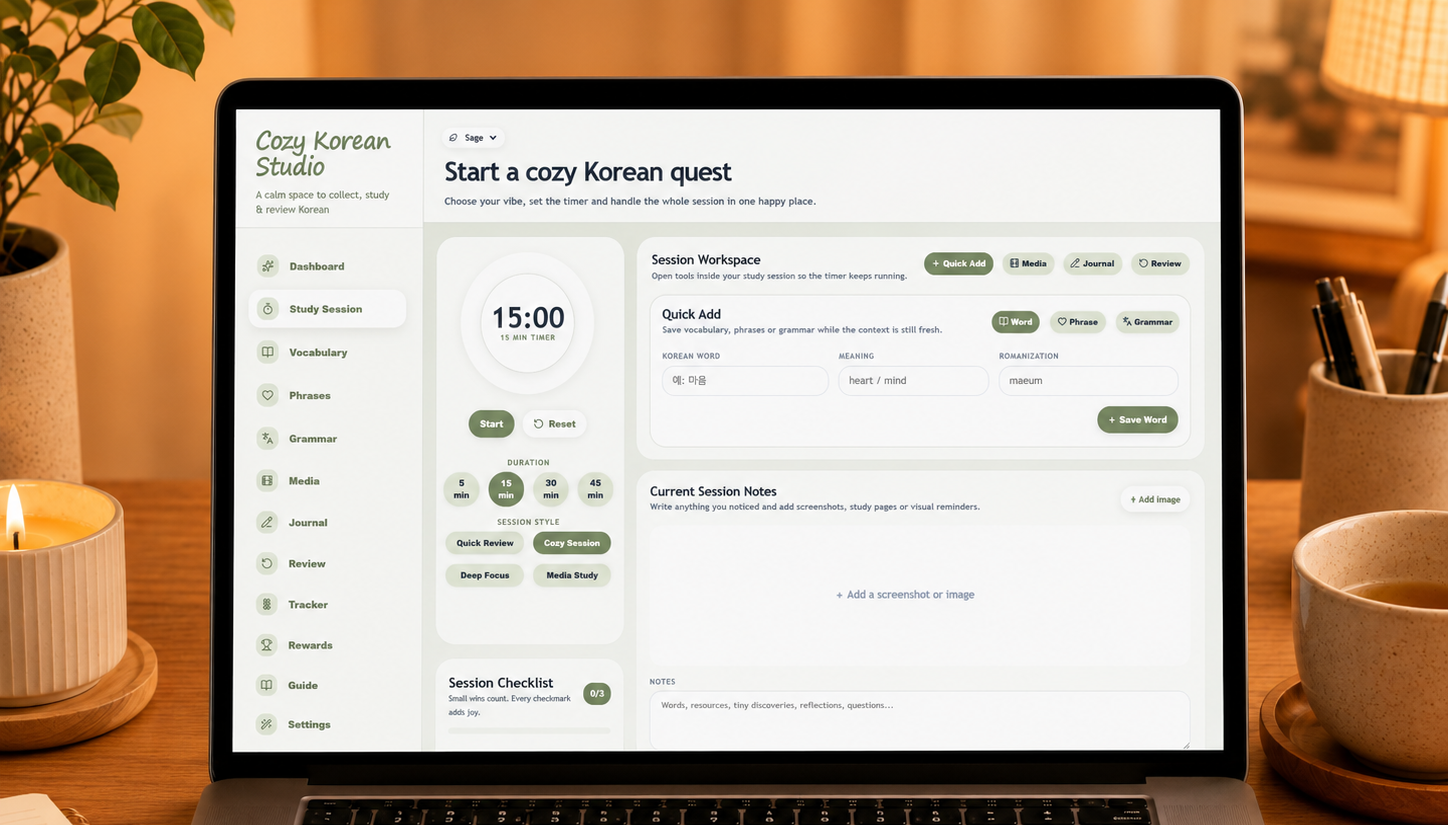
That is one of the reasons I created Cozy Korean Studio, my offline Korean Study Web App.
It is designed as a calm space to collect, study, and review Korean without needing to turn your learning routine into a complicated productivity system.
You can use it to save vocabulary, phrases, grammar notes, K-media study notes, journal entries, and review material in one place. It is not meant to replace every worksheet, notebook, or lesson you use. It is meant to give your Korean self-study a home.
How to combine worksheets with a Korean study system
Printable Korean worksheets and a digital study system can work really well together.
You do not have to choose only one.
For example, you can use a printable worksheet to practice a grammar pattern by hand. Then, after finishing the worksheet, you can save the most important grammar point and your own example sentence in your Korean study system.
Or you can use a vocabulary worksheet to learn new words, then move your favorite words into your vocabulary tracker for review.
Here is a simple flow:
- Learn with a worksheet, video, lesson, drama, or textbook.
- Choose the most useful words, phrases, or grammar points.
- Save them in your Korean study system.
- Review them later.
- Use them in your own sentences.
This keeps your routine clean.
You are not trying to save everything. You are choosing what deserves to come back in review.
That is the difference between collecting Korean resources and actually using them.
A calm Korean study routine is better than a perfect one
It is easy to think you need the perfect routine before you can make real progress.
The perfect notebook.
The perfect app.
The perfect worksheet.
The perfect schedule.
The perfect study aesthetic.
But Korean learning does not require perfection.
It requires returning.
Returning to your words.
Returning to your phrases.
Returning to your grammar notes.
Returning to your review sessions.
Returning to the reason you started.
A calm Korean study routine gives you enough structure to continue, but not so much pressure that you quit.
Start small.
Save a few words.
Write one sentence.
Review one phrase.
Track one session.
Watch one scene with attention.
Come back tomorrow, or the next day, and continue.
That is how Korean becomes part of your life.
Not through one perfect study day, but through many small returns.
Want a cozy place to organize your Korean studies?
Cozy Korean Studio is an offline Korean Study Web App where you can collect vocabulary, phrases, grammar notes, K-media study notes, journal entries, review material, and study progress in one calm space.
Explore the Korean Study Web AppFinal thoughts
Learning Korean at home can feel overwhelming when your notes, worksheets, phrases, grammar points, and media inspiration are scattered everywhere.
But your routine does not need to be complicated.
- Choose one small focus.
- Save your vocabulary with context.
- Keep phrases separate.
- Make grammar practical.
- Use Korean media actively.
- Review before adding more.
- Track your progress gently.
And most importantly, create a study space you actually enjoy coming back to.
You can build that space with a notebook, printable worksheets, a digital planner, or any tool that fits your learning style.
And if you want a cozy offline place made specifically for Korean self-study, I created Cozy Korean Studio, an offline Korean Study Web App where you can collect vocabulary, phrases, grammar, K-media notes, journal entries, review material, and study progress in one calm space.
Explore the Korean Study Web App here.
FAQ: Korean Study Routine
What should a Korean study routine include?
A simple Korean study routine should include vocabulary, phrases, grammar, listening or reading input, sentence practice, and regular review. You do not need to study everything every day. A small repeatable routine is easier to maintain.
How long should I study Korean every day?
Even 10–20 minutes can be helpful when your session has a clear focus. A short session could include reviewing old words, practicing one grammar pattern, saving a few useful phrases, or writing one simple sentence.
How can I remember Korean vocabulary better?
Try learning Korean words with context instead of memorizing isolated word lists. Add example sentences, categories, sources, and regular review. Words are easier to remember when they are connected to real usage.
Can I learn Korean with K-dramas or K-pop?
Yes, but it works better when you use Korean media actively. Instead of trying to understand everything, save one useful word, one phrase, and one sentence pattern from a scene, song, or video. Then review them later.
What is the best way to organize Korean study notes?
The best way is to keep your main learning material easy to find again. You can use a notebook, printable worksheets, a digital planner, or an offline Korean study web app. The tool matters less than whether you actually return to it.
Do I need a Korean study planner?
You do not need one, but a planner or study system can help if your notes are scattered. A Korean study planner can make it easier to track vocabulary, phrases, grammar, reviews, and study progress in one place.
One comment