
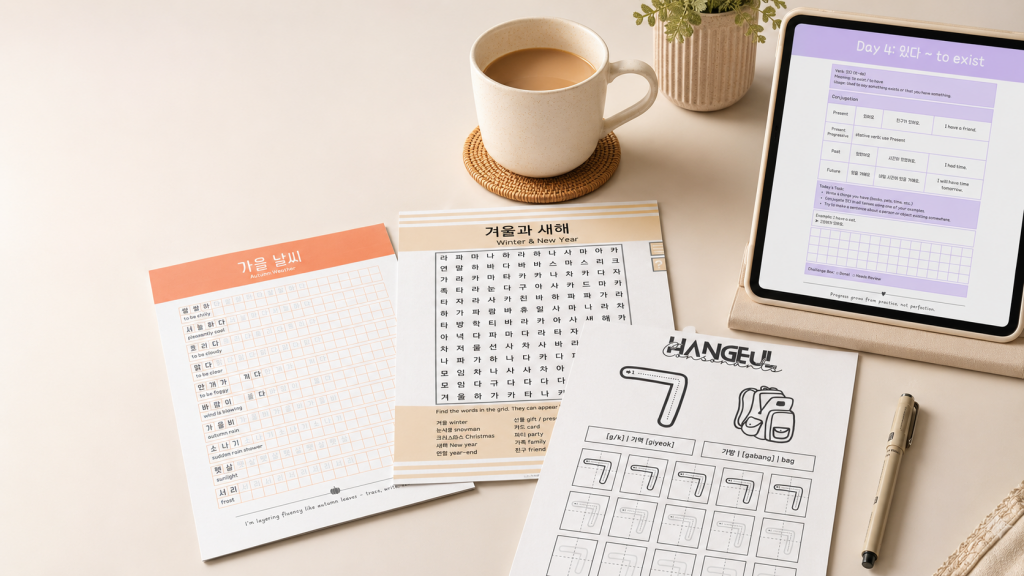
Learning Korean at home with Printable Korean Worksheets can feel exciting at first.
- You download an app.
- You save a few YouTube videos.
- You buy a textbook.
- You make a cute study playlist.
- You tell yourself: “This time, I will finally stay consistent.”
And then, a few days later, everything starts to feel a little messy.
- You are not sure what to study next.
- You have too many open tabs.
- You keep jumping between Hangul, vocabulary, grammar, K-drama phrases, flashcards, and random notes.
- You want to make progress, but your study routine feels more chaotic than calm.
That is where printable Korean worksheets can help.
They will not magically make you fluent overnight, and they do not replace listening, speaking, or real language practice. But they can give your self-study routine something many beginners are missing: structure.
Printable worksheets make Korean feel more visible, more organized, and easier to return to. Instead of wondering what to do every time you sit down, you have a simple page in front of you and one clear task to complete.
This guide will show you how to use printable Korean worksheets at home in a gentle, realistic way, especially if you are a beginner or returning learner.
Why printable Korean worksheets can help beginners
When you are learning Korean by yourself, one of the hardest parts is not always the language itself.
Sometimes the hardest part is knowing what to do next.
A worksheet gives you a small, focused learning task. That can be especially helpful if you feel overwhelmed by too many resources. Instead of trying to study everything at once, you can slow down and practice one skill at a time.
Printable Korean worksheets can help you:
- practice Hangul by hand
- review vocabulary in a structured way
- build simple Korean sentences
- repeat grammar patterns
- organize what you have already learned
- create a study routine that feels doable
This matters because language learning needs repetition. You usually do not remember a word, letter, or grammar pattern just because you saw it once. You need to meet it again, write it again, read it again, and use it again.
Spaced practice and retrieval practice are often used in language learning because repeating and recalling vocabulary over time can support long-term retention. The Australian Education Research Organisation gives an example from beginner language learning where vocabulary is broken into manageable blocks, revisited, and used again over several lessons instead of being taught all at once.
That is exactly where worksheets can be useful.
They give you a place to come back to.
What kind of printable Korean worksheets should beginners use?
Not every worksheet has the same purpose.
If you are just starting Korean, it helps to choose worksheets based on the skill you want to practice. Otherwise, it is easy to print too many pages and still feel lost.
Here are the main types of Korean worksheets I recommend for beginners.
1. Hangul practice worksheets
Hangul is the Korean writing system. Modern Hangul uses 24 basic letters, 14 consonants and 10 vowels. These letters are combined into syllable blocks, which is why Korean words look visually different from English words written letter by letter.
For beginners, Hangul worksheets are usually the best place to start.
Good Hangul practice worksheets can help you:
- recognize Korean letters
- practice stroke order
- write consonants and vowels
- build simple syllables
- read short Korean words
- feel more confident looking at Korean text
When you practice Hangul, do not rush through the whole alphabet in one sitting. It is much better to work in small groups.
For example:
Day 1: practice ㅏ, ㅓ, ㅗ, ㅜ
Day 2: practice ㄱ, ㄴ, ㄷ, ㄹ
Day 3: combine them into simple syllables
Day 4: review and rewrite the ones that still feel confusing
A simple worksheet can turn Hangul from “a wall of symbols” into something your hand and eyes slowly get used to.
2. Korean vocabulary worksheets
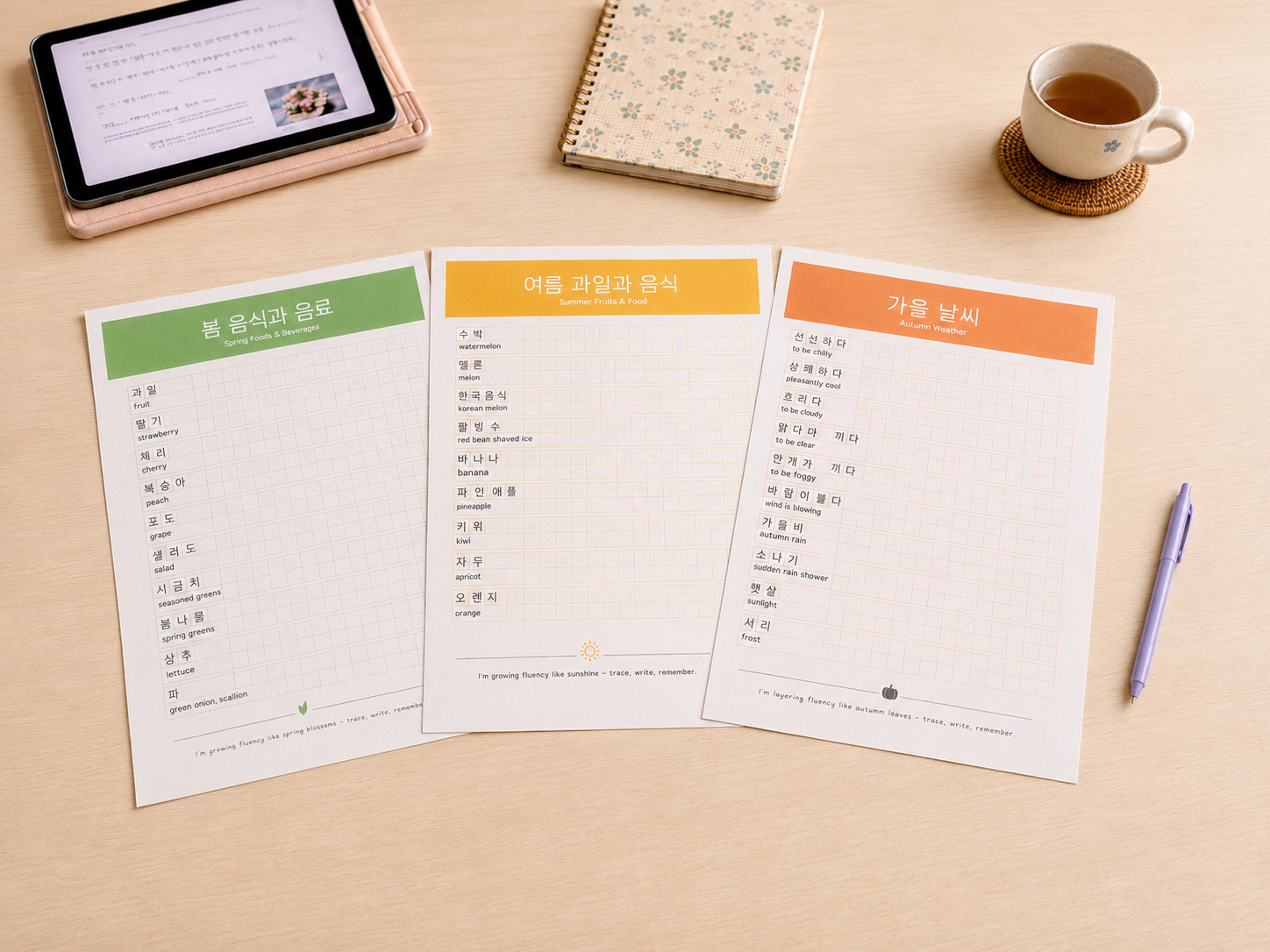
Vocabulary worksheets help you collect and review words in a way that feels organized.
Instead of writing random words into random notebooks, you can use themed pages.
For example:
- food vocabulary
- weather vocabulary
- café vocabulary
- daily routine vocabulary
- K-drama phrases
- verbs for beginners
- adjectives for beginners
- seasonal Korean words
The key is not to write down 50 new words at once.
A better beginner routine is:
- Choose 8 to 12 words.
- Write the English meaning.
- Write the Korean word.
- Read the word out loud.
- Copy it once or twice.
- Add one tiny example phrase or sentence.
- Review the same words again later.
The goal is not to make the page look perfect. The goal is to give your brain more chances to meet the same word.
For example:
Korean word: 커피
Meaning: coffee
Simple phrase: 커피를 마셔요.
Meaning: I drink coffee.
This kind of simple repetition is much more useful than collecting hundreds of words you never review.
3. Korean sentence building worksheets
At some point, vocabulary lists are not enough.
You also need to understand how Korean sentences work.
This is where many beginners start feeling confused, because Korean sentence order is different from English. In English, you might say:
I drink coffee.
But in Korean, the structure is more like:
I coffee drink.
저는 커피를 마셔요.
That is why sentence building worksheets can be so helpful. They slow the sentence down and help you see the parts.
A good sentence practice page might include:
- the English sentence
- vocabulary support
- space to write the Korean sentence
- an answer key
- a short explanation
For example:
English: I drink coffee.
Vocabulary:
I = 저
coffee = 커피
to drink = 마시다
Korean sentence: 저는 커피를 마셔요.
This helps you understand the logic instead of just memorizing full sentences.
Sentence worksheets are especially useful when you are learning:
- basic Korean word order
- polite present tense
- simple verbs
- basic daily life sentences
- translation practice
If you often think, “I know some Korean words, but I cannot build sentences,” this type of worksheet is probably exactly what you need.
4. Korean grammar worksheets
Grammar can feel scary when it is explained in a complicated way.
But beginner grammar does not have to be overwhelming.
A grammar worksheet should focus on one small pattern at a time.
For example:
- -아요 / -어요
- 이에요 / 예요
- 은 / 는
- 이 / 가
- 을 / 를
- 안 + verb
- -고 싶어요
- -고 있어요
Instead of reading a long explanation and then moving on, use the worksheet to apply the pattern.
A simple grammar page could look like this:
Pattern: -고 싶어요
Meaning: want to do something
먹다 = to eat
먹고 싶어요 = I want to eat
보다 = to watch
보고 싶어요 = I want to watch
가다 = to go
가고 싶어요 = I want to go
Then you practice with your own examples.
This is the part that matters most: do not only read grammar. Use it.
Even if your sentences are simple, you are training yourself to recognize patterns and build with them.
5. Korean study planner pages
A study planner is not just cute stationery.
It can help you stop restarting Korean every few weeks.
Many beginners do not quit because they dislike Korean. They quit because their routine becomes too big, too vague, or too hard to continue.
A Korean study planner can help you decide:
- what you want to study this week
- which worksheets you want to use
- which vocabulary you want to review
- what you already practiced
- what still feels confusing
- when to take a review day
Your weekly plan does not need to be intense.
It can be as simple as:
Monday: Hangul review
Tuesday: 10 vocabulary words
Wednesday: sentence practice
Thursday: listening practice
Friday: worksheet review
Saturday: K-drama or music notes
Sunday: rest or light review
A gentle routine is better than an unrealistic one.
You do not need to study for two hours every day to make progress. You need a rhythm you can come back to.
How to avoid worksheet overwhelm
Printable worksheets are helpful, but only if you use them in a calm and realistic way.
It is very easy to print too much.
You find a cute workbook.
Then another one.
Then a 50-page PDF.
Then a study planner.
Then vocabulary pages.
Then grammar pages.
Suddenly, your “simple Korean routine” becomes another pile of pressure.
Here is how to avoid that.
Print only what you need right now
You do not need to print the whole workbook today.
Choose one small section.
For example:
- one Hangul page
- one vocabulary page
- one sentence practice page
- one weekly planner
That is enough.
A printable page should make studying feel easier, not heavier.
Repeat pages instead of always adding new ones
Beginners often want new material because new material feels exciting.
But Korean becomes easier through repetition.
So before you print another page, ask:
- Have I reviewed the last one?
- Can I read the words from last week?
- Can I write the sentences again without looking?
- Do I understand my mistakes?
Sometimes the best next step is not a new worksheet.
Sometimes the best next step is using the same page again.
Keep one Korean study binder or folder
If you enjoy printables, a simple Korean study binder can be very helpful.
You can organize it into sections like:
- Hangul
- Vocabulary
- Grammar
- Sentence Practice
- Review
- Study Planner
- K-drama Notes
This keeps your pages from getting lost and makes your progress visible.
When you feel unmotivated, flipping through your older pages can remind you that you have already learned more than you think.
Use printable Korean worksheets together with listening and speaking
Worksheets are wonderful for structure, writing, and review.
But Korean is still a living language.
So try to combine worksheet practice with listening and speaking, even in tiny ways.
For example:
After a vocabulary worksheet, listen for one of the words in a Korean video.
After a sentence worksheet, read your sentence out loud.
After a Hangul worksheet, try reading a Korean word without romanization.
After a grammar worksheet, make one sentence about your own life.
This keeps your study routine from becoming only paper-based.
You are not just filling out pages. You are slowly building language you can recognize, read, say, and use.
Want a calmer way to study Korean?
If you often feel overwhelmed by too many Korean resources, you are not alone.
I created the Hanyari Study Club for learners who want Korean to feel more gentle, organized, and doable.
You can join and get a beginner-friendly printable study kit to help you start small, stay consistent, and build a calmer Korean study routine.
Digital Korean worksheets vs printable Korean worksheets
You do not have to choose only one.
Printable Korean worksheets are great if you like:
- using a binder
- decorating your study pages with glue
- stepping away from screens
Digital Korean worksheets are great if you like:
- studying on an iPad or tablet
- using GoodNotes or similar apps
- reusing pages
- keeping everything in one place
- studying while traveling
Many learners use both.
You might use printable pages for handwriting and review, then use digital pages for quick practice during the week.
The best format is the one you will actually use.
How to choose the right printable Korean worksheets for your level
If you are not sure where to start, choose based on your current level.
If you are an absolute beginner
Start with:
- Hangul practice
- basic syllables
- simple Korean words
- handwriting pages
- beginner vocabulary
Your goal is to feel comfortable seeing and writing Korean.
Do not rush into long grammar explanations too soon.
If you already know Hangul
Start adding:
- vocabulary worksheets
- simple sentence building
- basic particles
- polite present tense
- short reading practice
Your goal is to move from recognizing Korean to using Korean.
If you are a returning learner
Start with review.
Use worksheets to find what you remember and what needs practice again.
Good choices are:
- mixed Hangul review
- beginner sentence practice
- verb conjugation pages
- vocabulary refresh pages
- study planner pages
Returning to Korean does not mean starting from zero.
It means rebuilding your routine gently.
Helpful Korean study printables from Hanyari Design
If you enjoy calm, structured Korean self-study, you can explore my printable and digital Korean study tools.
At Hanyari Design, I create beginner-friendly resources for learners who want Korean printables to feel less chaotic and more doable. You will find Hangul practice pages, vocabulary worksheets, grammar and sentence practice workbooks, study kits, and cozy printables designed to help you come back to Korean again and again.
You can find my Printable Korean Worksheets and more in my Etsy shop.
Final thoughts
Printable Korean worksheets are not about making your study routine perfect.
They are about making Korean feel a little more manageable.
One page.
One word list.
One sentence pattern.
One small review session.
One gentle step back into learning.
That is enough.
You do not need to do everything at once. You do not need twenty apps open. You do not need a perfect study plan before you begin.
Start with one worksheet.
Write slowly.
Review often.
Say things out loud.
Come back tomorrow.
That is how small pages can become real progress.
2 comments